



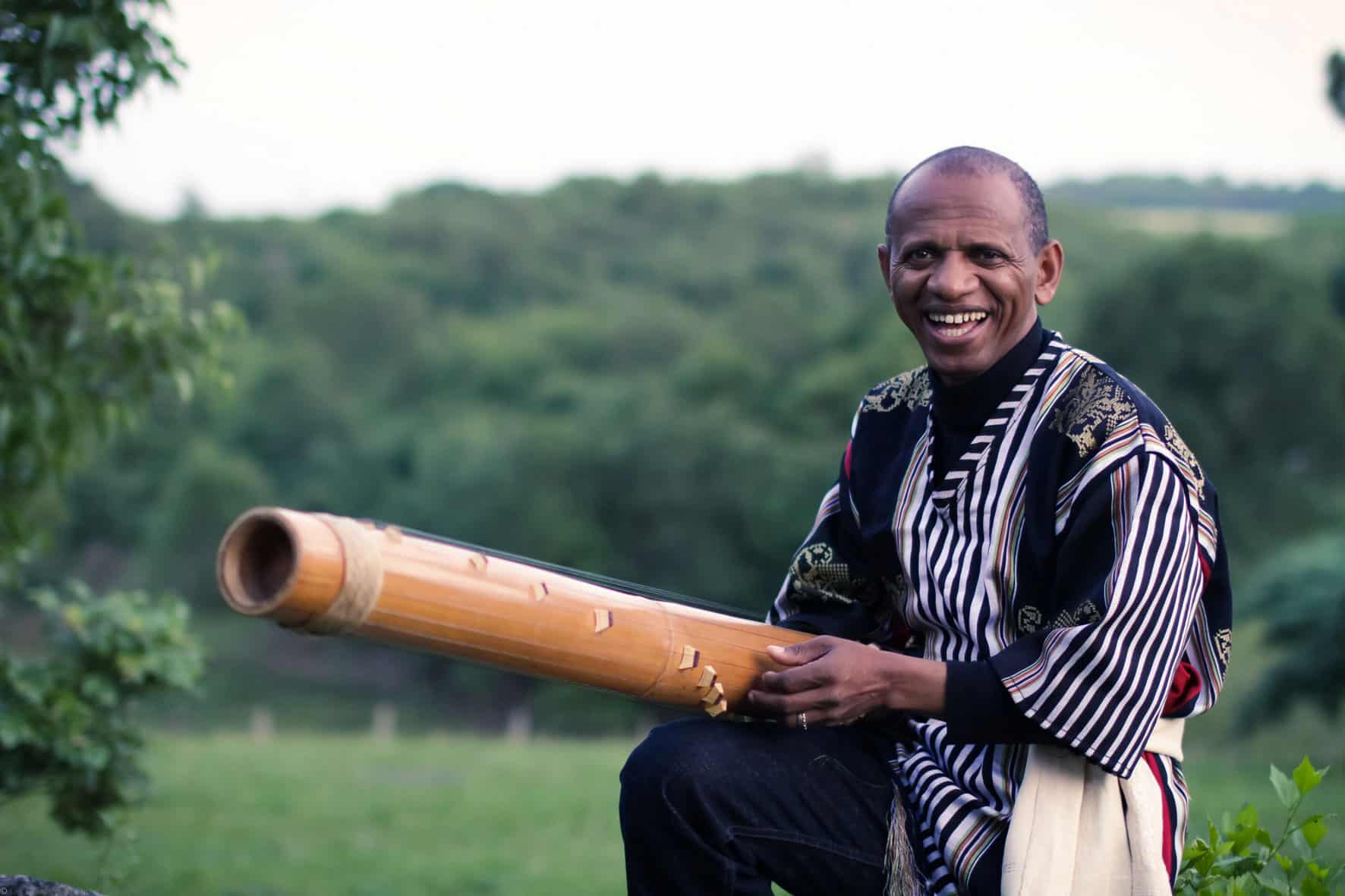
According to Indonesian tradition, the origin of Sasando is linked to a young boy from the island of Rote, Sangguana. The story goes that one day when he was feeling tired, he fell asleep under a tree. Sangguana then dreamed of playing beautiful music with a unique instrument whose melody would be enchanting. When he woke up, Sangguana still remembered the sounds he was playing in his dream. Not wanting to lose these beautiful sounds, he tried to recreate them by inventing a new musical instrument, the sasando, with the tree under which he had fallen asleep. Probably came with successive waves of migration to Madagascar, the sasando was gradually simplified, until it only had the base of the instrument: the bamboo body and the fiber strings. From there, was born the valiha.
It is found throughout Madagascar. Variants, sometimes more primitive, sometimes more evolved, are found among most mountain Malay peoples, including those of the Philippines. It is also present among peoples of the same origin (the Jara, Edde, Curu, Raglai) of the Indochinese peninsula.
It is composed of a segment of bamboo (60 to 130 cm long) serving both as a soundboard and as a resonator thanks to a long longitudinal slit (hearing) between the undrilled nodes of the ends.
Initially, the ropes were made by detaching the longitudinal fibers from the bark of the central bamboo to which they remained attached by their two ends. Shaped in the form of basic ropes, and raised above the table, they rested on small trestles cut from a piece of gourd bark arranged around the bamboo, in two symmetrical half-helices: with a low pitch of a side (multiple, fixed bridges), with large steps on the other (multiple, mobile saddles), the latter alone being used for tuning the instrument by adjusting the vibrating length of the string.
The fibrous "strings" gave muffled percussion sounds: later, they were replaced by steel strings with quite satisfactory results, giving the current instrument a characteristic timbre, closer to the zither.
On the other hand, attempts at electric valiha were not successful because they made it lose its romantic and intimate sound; however, a modern variety, mounted on a sound box, has become very popular.
Game
It is played standing or seated, the instrument wedged under the arm, both hands free to pinch it. (wikipedia)
30 July 2016
1 comment

https://www.youtube.com/watch?v=cwXN_2tJnzE