



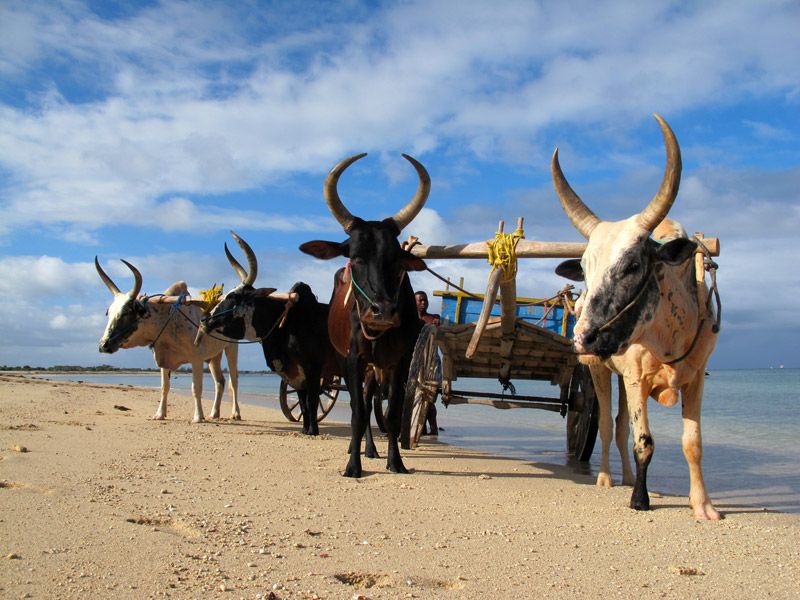
The zebu (Bos taurus indicus) is a domestic bovid descended from an Indian subspecies of the aurochs. The word zebu comes from the Tibetan “zeba” meaning etymologically “hump”.
Previously having the status of a separate species (Bos indicus), the zebu is currently considered by the majority of authors as a subspecies of Bos taurus: Bos taurus indicus. According to the current tendency of biologists to reclassify domestic species as a simple subgroup of original wild species, the zebu is often presented under the name of Bos primigenius indicus.
A fatty bump raises the level of the withers, especially in males, this bump being small or large, straight or drooping depending on the breed. It constitutes a caloric reserve that allows them to withstand periods of scarcity: it swells in the wet season and deflates during the dry season.
Depending on the breeds and the richness of the pastures, individuals can weigh from 200 kg to more than a ton.
In India, it is bred for its milk and its labor power. In the other countries, production was also oriented towards meat. When European selection has worked, their productivity almost equals that of European cattle, but in climatic environments where only zebus can be profitable.
Since the zebu is a bovine, the list of existing breeds is included in the List of cattle breeds. It is also difficult to distinguish between Eurasian cattle and zebu in Africa, as the interbreeding between the two branches has been significant and repeated.
Among the peoples of Africa practicing nomadism and pastoralism, such as the Maasai, the Fulani or certain ethnic groups of Madagascar, the prestige of families is measured by the size of the herds. Thus, the animals are very rarely slaughtered. Their breeders use their milk; even if the production per animal is low, the milking is done in rotation on all the females, thus ensuring a sufficient quantity for the tribe. Among the Maasai, blood is drawn using an arrow from a vein in the animals' necks. They thus provide a product rich in protein and iron, without having to slaughter the animal.
In Madagascar, there is a sport called savika, a kind of bullfighting without killing zebu. The principle is to cling with his hands to the hump of the upper back of the zebu and to use his legs as springs to avoid being trampled by the legs of the zebu. Those who practice this sport are called "mpisavika" in Madagascar. In addition, the Madagascar football team today bears the name of a breed of zebus called 'Barea’ which has its share of history for the Malagasy.
Symbol of royalty, the zebu of Madagascar is a sacred animal. A sign of wealth and opulence, it has marked the history and life of the Malagasy people. From birth to death, the zebu accompanies the daily life of the population.
Wikipedia ©
7 June 2020
0 comment

Comment (0)