



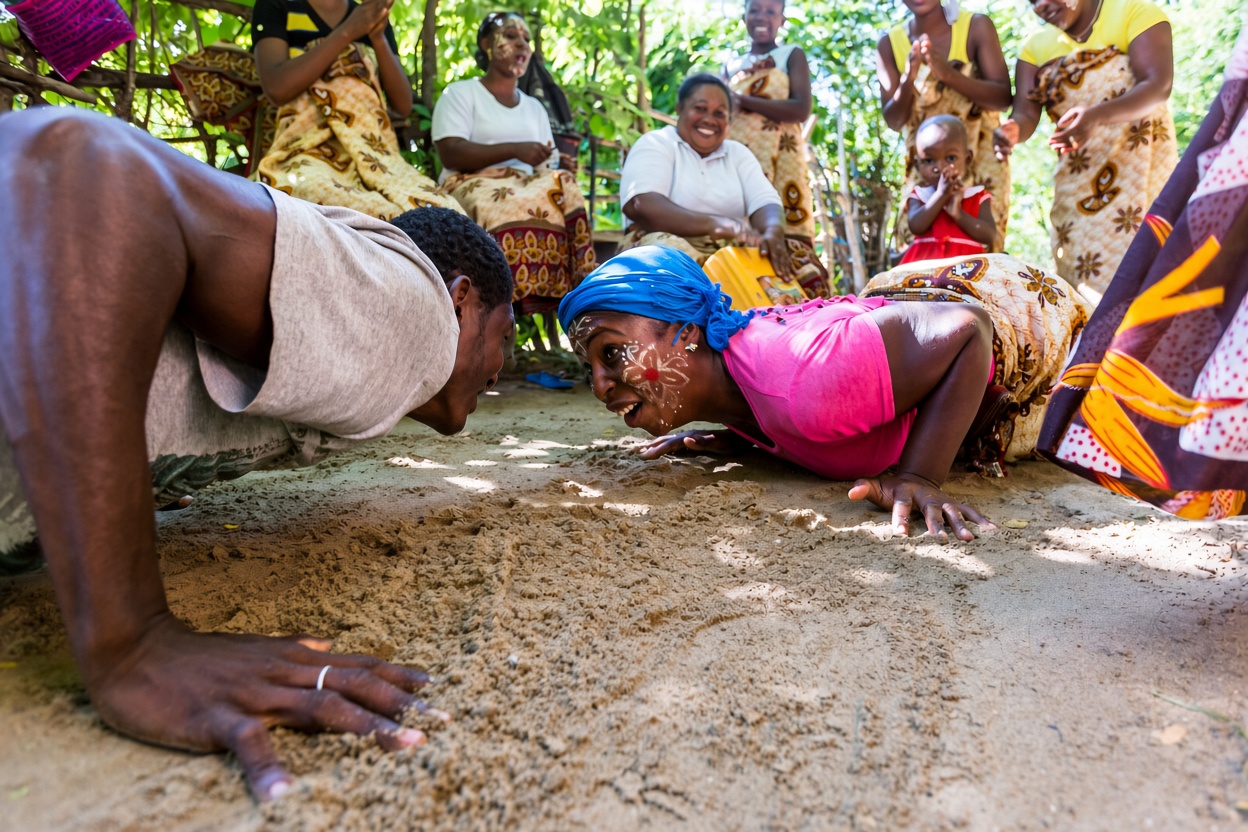
Ancestral Culture of Madagascar: Dihamboay, a sacred dance of the Antakarana and Sakalava
Ancestral Culture of Madagascar : in the north of the Big Island, the crocodile occupies a particular place in the imagination, traditions and beliefs of several communities, particularly among Antakarana and the Sakalava. Much more than a simple animal living in rivers, lakes and wetlands, the crocodile, called crocodile in Malagasy, is associated with power, protection, wisdom and the world of the ancestors. This special relationship between man and animal is manifested in particular through Dihamboay, literally the “crocodile dance”, a remarkable expression of the Ancestral Culture of Madagascar.
The voay, an animal respected in Malagasy traditions
The crocodile has long been present in the natural environment of Madagascar. Its power, its longevity and its mysterious behavior have naturally contributed to giving it a particular dimension in traditional beliefs.
In some communities in northern Madagascar, the crocodile is viewed with respect and caution. It belongs to this universe where nature, ancestors and the living are intimately linked. In traditional Malagasy conception, certain animals can be associated with invisible forces, ancient stories or the presence of ancestors.
This perception does not necessarily mean that all Malagasy communities view the crocodile in the same way. Beliefs vary greatly from region to region and from cultural group to cultural group. Among the Antakarana and the Sakalava, however, the crocodile can take on an important symbolic dimension in certain traditions and ceremonies.
Dihamboay, the crocodile dance
the Dihamboay is a traditional dance whose name refers to the crocodile. The movements performed by the dancers evoke the movements and attitudes of this powerful animal.
Accompanied by percussion, songs and sometimes ceremonial rhythms, this dance constitutes much more than a simple artistic representation. It can express strength, vigilance, power and the connection with the ancestors.
The movements of the body, the gestures of the arms and the way in which the dancers move can recall the progression of the crocodile in its natural environment. The show thus becomes a way of symbolically representing the animal and the values associated with it.
In the context of the Ancestral Culture of Madagascar, traditional dances often play an essential role in the transmission of collective memory. They allow stories, symbols and values to be transmitted from one generation to another, sometimes without resorting to writing.
Antakarana and Sakalava: a special relationship with the natural world
The north of Madagascar has exceptional cultural wealth. THE English, a people historically established in the north of the island, and the Sakalava, present mainly in the west and north-west of Madagascar, have developed over generations traditions deeply linked to their environment.
The sea, forests, mountains, rivers and animals occupy an important place in traditional stories and representations.
The crocodile belongs to this natural universe which goes beyond the simple notion of biodiversity. It can become a cultural and spiritual symbol, especially when associated with ancestors and the forces that protect the community.
This design recalls a fundamental idea of the Ancestral Culture of Madagascar: nature is not always separated from the world of men. It can be considered as a space inhabited by forces, stories and memory that deserve respect and consideration.
The crocodile and the ancestors
In Malagasy traditions, the relationship with ancestors occupies a central place. THE ancestor, the ancestors, are considered an integral part of the social and spiritual life of the communities.
Certain animals can thus be associated with this relationship between the living and the ancestors. The crocodile, by its strength and impressive character, can be perceived as an animal with a particular dimension.
It is therefore important to understand the traditions around crocodile with respect and without reducing them to a simple tourist legend. These beliefs belong to a much larger cultural system in which ceremonies, dances, prohibitions, stories and relationships with nature form a coherent whole.
A dance that transmits memory
One of the great strengths of Dihamboay lies in its ability to transmit cultural memory.
In a society where oral transmission has historically played a major role, songs, dances and ceremonies make it possible to preserve part of the intangible heritage. Each movement can help tell a story, recall a belief or strengthen collective identity.
The crocodile dance thus becomes a true expression of Ancestral Culture of Madagascar. It allows younger generations to stay connected to a heritage passed down by their parents and grandparents.
It also represents another way of understanding Madagascar: not only through its extraordinary landscapes and its unique biodiversity, but also through the living traditions of its peoples.
A tradition between heritage and modernity
Today, Malagasy traditions are evolving. Globalization, urbanization and social transformations are gradually modifying cultural practices. Some ceremonies become less frequent, while others are adapted to the contemporary world.
In this context, preserving expressions like Dihamboay is particularly important. It is not only a question of preserving an ancient dance, but of protecting an intangible heritage which tells the relationship between a community, its environment, its ancestors and its history.
For travelers who wish to discover Madagascar differently, meeting these traditions can be a particularly powerful experience. It allows you to go beyond simple tourist discovery and approach a culture deeply rooted in its territory.
The crocodile, symbol of a Madagascar deeply linked to its roots
The Malagasy crocodile, oh crocodile, ultimately recalls the complexity and richness of the relationships between man and nature in Madagascar. Through Dihamboay, the Antakarana and the Sakalava express part of their cultural heritage and their relationship to the world.
The Ancestral Culture of Madagascar is therefore not limited to monuments, ancient objects or historical sites. It also lives in songs, dances, ceremonies, stories transmitted orally and in the way communities perceive their environment.
The Dihamboay, the “crocodile dance”, is a beautiful illustration of this: behind the movements inspired by crocodile there are values of strength, respect, protection and memory. A tradition which reminds us that, on the Big Island, nature and culture are often closely linked.
Discovering the crocodile through this perspective is ultimately discovering another facet of Madagascar: that of a country where the Ancestral Culture of Madagascar continues to live through its peoples and traditions.

Comment (0)