



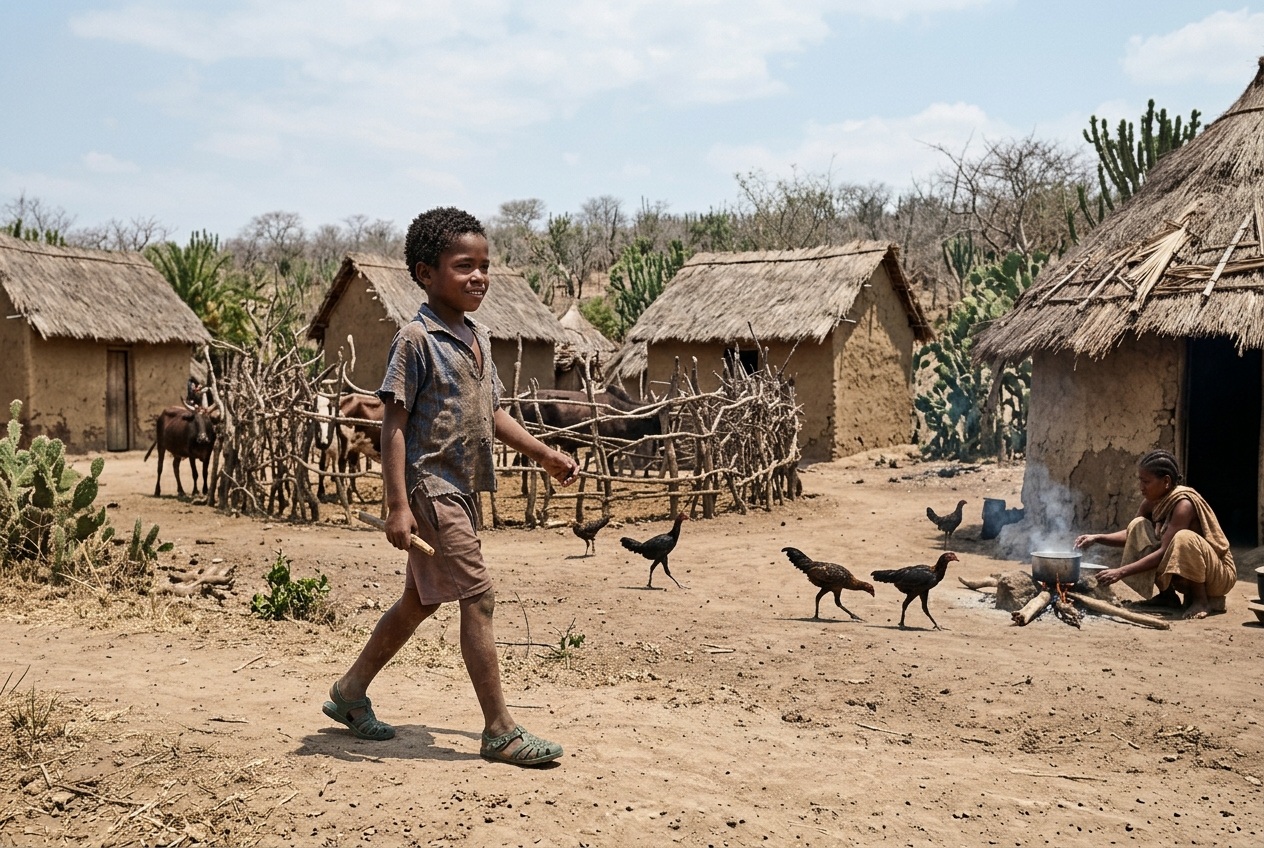
A day in Madagascar: in the daily life of a Mahafaly child in the heart of the thorny bush of the South
The sun rises over the thorny bush of southern Madagascar. On the horizon, the golden light reveals an arid landscape, dotted with cacti, euphorbias and thorny bushes. Here, the land is dry, rain is rare and the wind sometimes raises fine red dust. It is in this harsh environment, but full of life, that begins a day in Madagascar, alongside a child from the Mahafaly ethnic group.
Waking up in a village in southern Madagascar
His name is Tsiory. He is nine years old and lives with his family in a small traditional hut built from materials available in his environment. The walls are made of branches, wood and plants, while the roof, depending on the family's means, is covered with dried leaves and thatch. Around the hut, a few enclosures demarcate the family space. A zebu stands in the shade, while chickens scratch the ground in search of food.
At the first light of day, Tsiory wakes up. In the cool of the morning, his mother prepares the meal with the resources available. Rice, when available, sometimes accompanies cassava, corn or sweet potatoes. Water, precious in this region, must be used with care.
Tsiory wears simple clothes, often worn from play, dust and long walks. His bare feet know the rocky paths and the thorns that litter the ground. For him, this landscape is not an exotic setting: it is his universe, the one in which he grows and learns every day.
School, herds and small jobs
After breakfast, Tsiory's day is organized according to the needs of his family. When he goes to school, he takes a dirt path that winds between thorny bushes and termite mounds. The distance is long. In some isolated villages, access to school remains difficult, particularly during periods of drought or when families live far from school establishments.
In the class, he finds his classmates. They learn to read, write and count, while talking about their village, their families and the little-known world that extends beyond their horizon. School represents an opportunity to discover other perspectives, even if the material conditions are sometimes modest.
On days without classes, or after classes, Tsiory can help his parents look after the goats, watch over the zebu or bring in small supplies. In some families, children also participate in collecting wood, fetching water or other tasks appropriate to their age.
The zebu occupies an important place in the life of many communities in southern Madagascar. It represents wealth, a means of subsistence and a social and cultural symbol. Among the Mahafaly, traditions, family ties and the relationship with the land contribute to shaping the identity of the community.
A world of thorny plants and wildlife
Walking alongside Tsiory, we discover an astonishing landscape. The tortuously shaped plants stand like natural sculptures. Didiereaceae, euphorbias and other species adapted to drought have developed remarkable strategies to survive in this demanding environment.
Between the thorns slip lizards, insects and small birds. In the distance, a bird of prey hovers in the sky. The vegetation sometimes seems impenetrable, but it is home to exceptional biodiversity, characteristic of this part of Madagascar.
For Tsiory, these plants are familiar landmarks. He knows where to put his feet, which passages to take and how to avoid the most aggressive branches. Where a visitor sees a hostile landscape, recognizes paths, resources and places full of memories.
However, this balance remains fragile. Drought, land degradation, pressure on natural resources and economic difficulties can complicate the lives of residents. The protection of biodiversity must therefore go hand in hand with respect for local communities and their needs.
The end of the day: stories at the foot of the hut
When the sun goes down, the heat becomes less intense. Tsiory reunites with his family. Activities slow down, the animals return to their enclosures and the last tasks are accomplished before nightfall.
Around the hearth, the meal is prepared. The conversations resume. The adults talk about news from the village, upcoming work and everyday concerns. Sometimes elders tell stories passed down from generation to generation. These stories help to preserve collective memory and transmit community values.
In the twilight, the southern Malagasy sky is gradually covered with stars. Far from big cities and their lights, the night seems immense. Tsiory falls asleep to the rhythm of the sounds of the village, with the same dreams as many children his age: to play, learn, grow and discover what exists beyond his familiar world.
A day in Madagascar, an encounter with another reality
Passer a day in Madagascar in the daily life of a child Mahafaly, even through the imagination, invites us to look at the country differently. Behind the beaches, the baobabs and the national parks lies another wealth: that of the inhabitants, their know-how, their traditions and their ability to live in demanding environments.
Discovering the South of Madagascar also means understanding that each landscape is an inhabited territory, with its challenges and its hopes. Responsible travel is not limited to photographing the landscapes. It also involves taking the time to listen, understand and respect those who live there.
Through Tsiory’s eyes, the thorny bush ceases to be a simple setting. It becomes a living world, where each path tells a story and where each day reveals another facet of the Big Island.
Madagascar cannot be discovered only with the eyes. It is also discovered through the lives that animate it.

Comment (0)