



At the heart of the nature and biodiversity of Madagascar, the mmigration of whales in Madagascar: an exceptional spectacle
Every year, when the southern winter sets in in the Indian Ocean, an extraordinary spectacle is prepared off the coast of Madagascar. Thousands of kilometers are traveled by humpback whales as they leave the cold waters of Antarctica to reach warmer waters, particularly around Madagascar. This seasonal migration constitutes one of the most beautiful natural phenomena to observe in the Indian Ocean and represents an unmissable experience for lovers of nature and the biodiversity of Madagascar.
Why do whales migrate to Madagascar?
Humpback whales carry out one of the most impressive migrations in the animal world. Some populations travel several thousand kilometers each year between their feeding areas, located in cold waters, and their breeding areas, located in tropical and subtropical waters.
During the southern winter, the waters around Madagascar become a real refuge for these large marine mammals. Their primary objective is to breed, give birth and raise their young in warmer, relatively protected waters.
Females accompanied by their newborns seek out calm, shallow coastal areas in particular. Antongil Bay, in the north-east of Madagascar, constitutes a particularly important area for the reproduction, birthing and rearing of calves.
When to watch whales in Madagascar?
The whale season in Madagascar generally takes place during the southern winter, mainly between July and September, with sightings that can vary depending on the year and region.
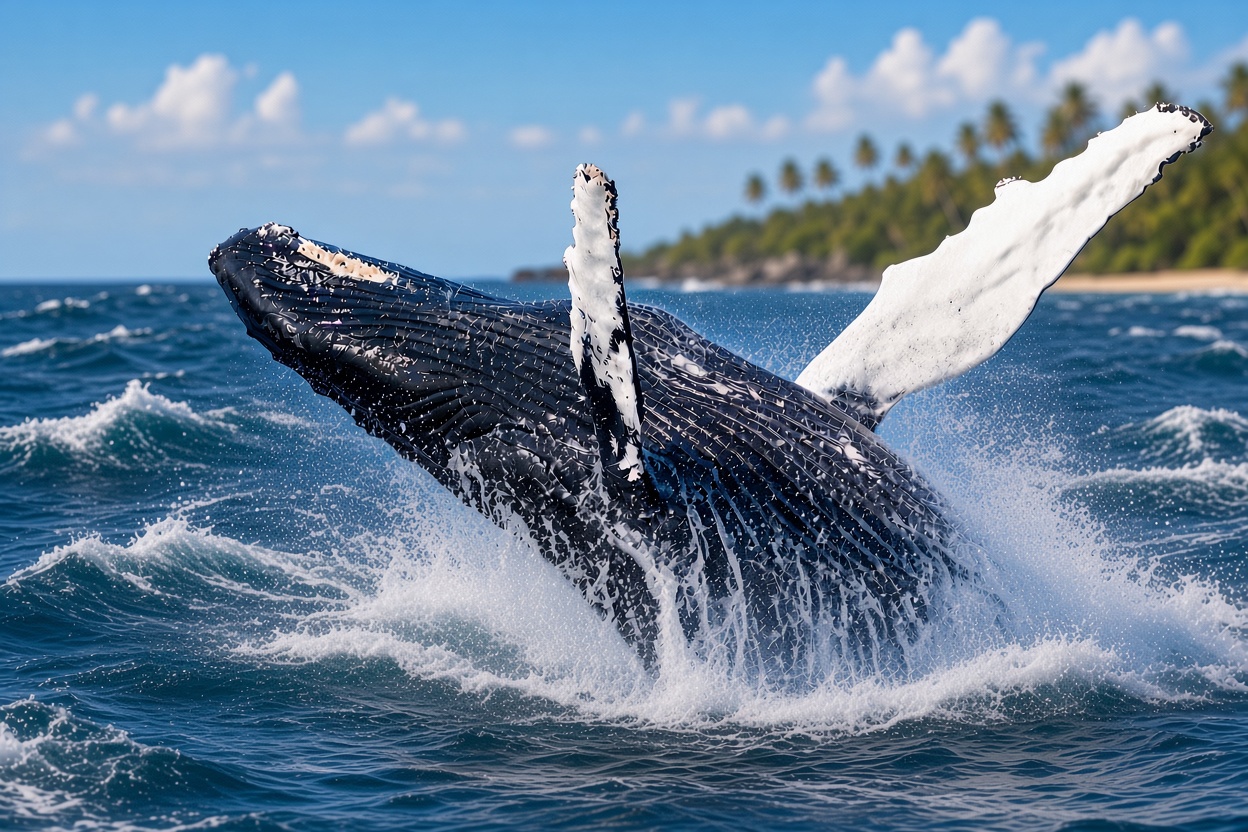
It is during this period that visitors can have the chance to observe humpback whales from the coast or during a boat trip. The spectacle can be striking: a whale emerging completely out of the water, a tail fin appearing on the surface, a powerful breath visible several hundred meters away or even a mother swimming peacefully with her calf.
For travelers who wish to discover the nature and biodiversity of Madagascar, this period offers a unique opportunity to combine cultural discovery, tropical landscapes and observation of marine fauna.
Sainte-Marie, an unmissable destination for seeing whales
Among the most famous destinations for whale watching in Madagascar, Sainte-Marie Island occupies a privileged place.
Located off the east coast of Madagascar, Sainte-Marie benefits from a marine environment that is particularly favorable for observing humpback whales. During the migration season, the waters surrounding the island become a veritable natural theater.
Sea excursions allow you to observe whales in their natural environment, without aquariums or artificial shows. With a little luck, visitors can witness spectacular behavior: jumps, fin strikes, blowing, diving or interactions between several individuals.
This proximity to wildlife also reminds us of the importance of responsible tourism. Whale watching must respect their natural behavior and maintain an appropriate distance so as not to disturb the animals.
Antongil Bay: a natural sanctuary
Further north, Antongil Bay is also a major site for humpback whales. The protected waters of this immense bay are particularly suitable for females and young calves.
The recommendations relating to whale watching precisely emphasize the need to limit the impact of boats on the movements and natural behavior of animals, particularly during the breeding period and when mothers are accompanied by their young.
Antongil Bay perfectly illustrates the richness of Malagasy marine ecosystems. Here, the discovery of whales can be combined with the exploration of tropical forests, coastal villages and other remarkable natural spaces.
Whales, a wealth of marine biodiversity in Madagascar
When we talk about the biodiversity of Madagascar, we often think of lemurs, chameleons, baobabs or orchids. However, the country's natural wealth does not stop at its land borders.
Malagasy waters are also home to a significant diversity of marine mammals. Humpback whales, dolphins and several other species of cetaceans frequent the waters around the Big Island.
Some species are particularly remarkable. The northwest of Madagascar is particularly known for the presence of the Omura whale, a rare species that is still relatively little studied. Unlike migratory humpback whales, Omura's whales observed in Madagascar do not appear to undertake long-distance migrations and can be present all year round.
This marine diversity fully contributes to the nature and biodiversity of Madagascar, making the island an exceptional destination for nature and ecotourism enthusiasts.
A trip that combines nature, adventure and discovery
Whale watching in Madagascar is not just a simple excursion at sea. It is an experience that allows you to understand the functioning of an ecosystem and the close relationship between the oceans, coasts and local populations.
A stay in Sainte-Marie can, for example, be combined with the discovery of the villages, plantations, beaches and landscapes of the east coast. In the northeast, a trip to Maroantsetra and Antongil Bay combines whale watching and the discovery of a region particularly rich in biodiversity.
For travelers interested in ecotourism in Madagascar, this approach allows for a more complete experience: observing animals in their natural environment while discovering the communities and landscapes that surround them.
Preserving whales for future generations
The annual whale migration is an extraordinary natural phenomenon, but it also serves as a reminder of the need to protect the oceans.
Whales face a variety of threats from human activities, including ship strikes, marine litter, noise pollution and accidental capture in some fishing gear. The protection of their habitats is therefore essential to maintain their populations and their migratory routes.
Observation tourism can contribute positively to this protection when practiced responsibly. Visitors learn about animals, develop a better understanding of marine ecosystems and indirectly participate in an economy that values nature conservation.
Every year, when humpback whales arrive in Malagasy waters, they offer travelers a unique encounter with nature. Between the turquoise waters of Sainte-Marie, the wild landscapes of the east coast and the spectacular Antongil Bay, Madagascar reveals another facet of its biodiversity.
Discovering whales ultimately means discovering Madagascar differently: a country where wildlife is not only found in forests and national parks, but also under the surface of the ocean. A true immersion in the heart of the nature and biodiversity of Madagascar.

Comment (0)