



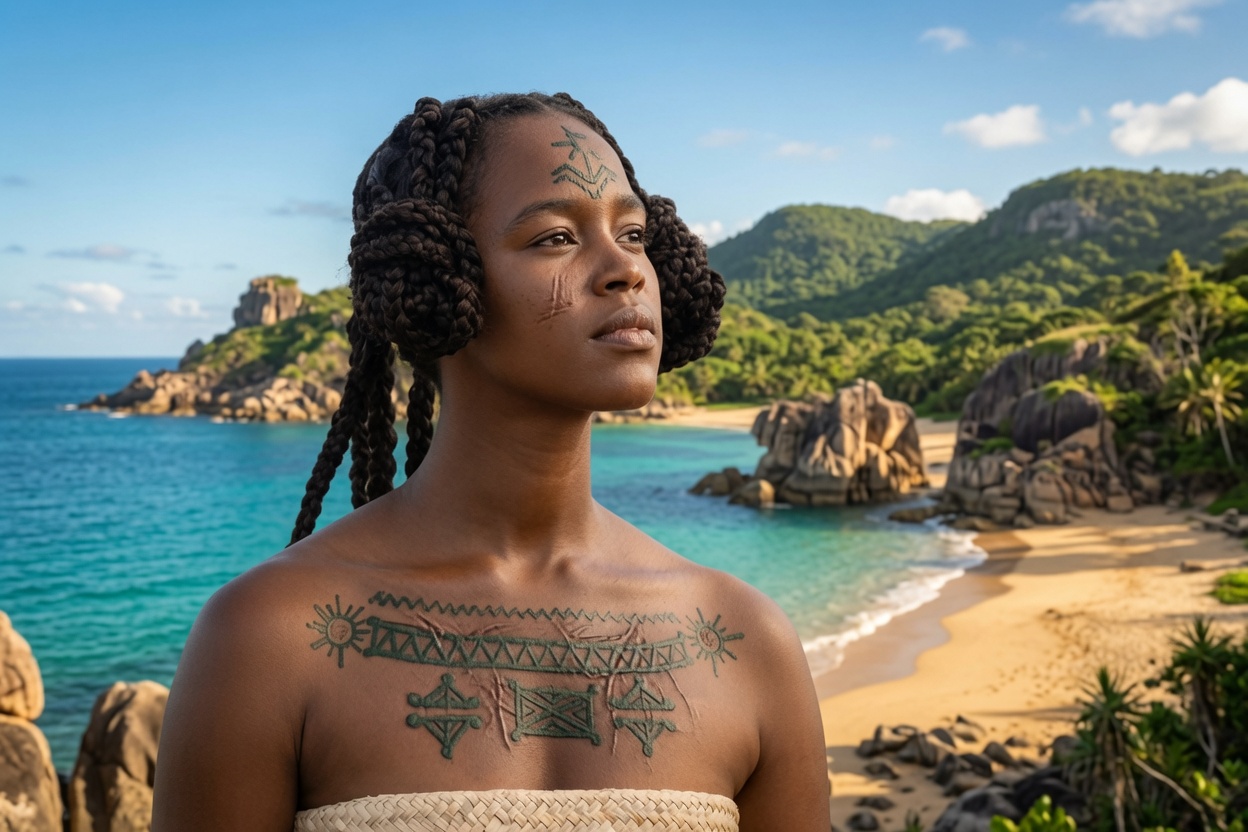
the traditional Malagasy tattoo, called Seal in Malagasy, constitutes one of the oldest cultural heritages of Madagascar. Much more than a simple body ornament, it represents a true spiritual language, an esoteric protection, a symbol of belonging and a bridge between the visible and invisible world. Today, while tattooing is booming worldwide, rediscovering ancestral Malagasy traditions allows us to better understand the cultural richness of the Big Island.
Tattooing has accompanied humanity for several millennia. The oldest traces date back more than 5,000 years, notably with the famous Ötzi mummy discovered in the Alps. The Egyptians, the peoples of Oceania, the Polynesians, the Japanese as well as many African civilizations already practiced tattooing for religious, medicinal or identity purposes. The first modern tattoo workshops and parlors gradually appeared in Europe in the 18th century thanks to seafaring explorers, before developing widely from the 19th century in large port cities such as London or Paris.
In Madagascar, several researchers believe that the practice of Tombokavatsa has been attested for at least 600 BCE, long before the arrival of historical kingdoms. Oral traditions and various researches mention in particular the Vazimba sovereigns Take care and ranked, often described as having ritual tattoos and pierced ears. These bodily marks symbolized their status as much as their connection with ancestors and the protective forces of nature.
Among the Behosy tribe from western Madagascar, as among the Water tribe, ancestors of the current Vezo according to certain traditions, tattooing occupied a central place in daily life. From one region of the island to another, each motif had a particular function. It was never a decoration carried out for aesthetic reasons only. Each symbol was chosen according to the person, their activity, their age, their lineage or even the dangers they could face.
Among the best-known motifs was the Tsimatahotioke, literally “he who does not fear the wind”. This tattoo was particularly sought after by herdsmen and travelers traveling the vast plains of Madagascar. Another reputed motive was the Hesitate, intended to protect its wearer against lightning and celestial powers. Other designs were associated with fertility, hunting, fishing, prosperity, courage or protection against illness and evil spirits.
the Seal thus constituted a true spiritual protection. In the traditional Malagasy conception, the body became a sacred support where invisible forces were inscribed capable of accompanying the person throughout their existence. The tattoo established a link between the living, the ancestors (Ancestors) and the different powers of nature.
This is why the tattoo artist was never a simple artist mastering drawing. The people authorized to perform these tattoos were generally Go ahead, of the Seer or An astrologer. These traditional knowledge holders had knowledge of ancestral medicine, rituals, Malagasy astrology, medicinal plants and the choice of favorable days. Before each tattoo, prayers, blessings and sometimes offerings accompanied the ceremony to guarantee the spiritual effectiveness of the symbol.
Beyond its mystical dimension, tattooing also played a social role. It made it possible to identify the origin of a person, their clan, their profession, their rank or even certain important stages of their life. Among several Malagasy peoples, tattoos marked the transition to adulthood, marriage or responsibilities acquired within the community.
Today, the traditional Malagasy tattoo is experiencing a real revival. Many artists are inspired by the ancient motifs of Seal in order to preserve this exceptional cultural heritage while adapting it to contemporary techniques. This renaissance contributes to transmit to new generations an essential part of Malagasy identity.
the Seal thus remains much more than a tattoo. It tells the history of Madagascar, the memory of its ancestors and a vision of the world where the body, nature and spirits remain deeply linked. Behind each motif hides a message, a protection and an identity that spans the centuries to remind us that Malagasy traditions continue to inspire and fascinate well beyond the borders of the Big Island.

Comment (0)