



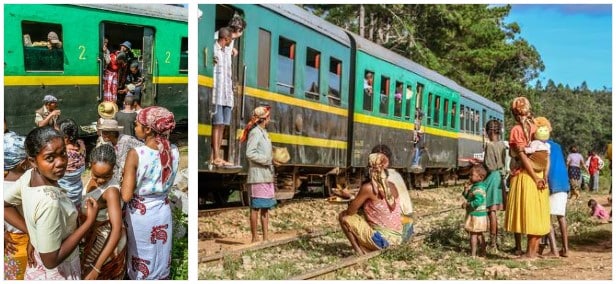
The Fianarantsoa-Côte Est (FCE) railway is a colonially built railway in southeastern Madagascar that connects the high plateau town of Fianarantsoa to the port town of Manakara. 163 kilometers long, it was built by the French between 1926 and 1936 thanks to the SMOTIG forced labor program. The French used rails and sleepers borrowed from Germany as World War I repairs to build the line. Many of the railways still bear the date of manufacture dating back to 1893.
In 2000, successive cyclones caused 280 landslides and 4 major service outages for months, until a rehabilitation project was launched with the help of USAID, Swiss Railways and other organizations. A study carried out by the Environmental Management Support Project (PAGE) in 2000 concluded that maintaining the train contributes to preventing deforestation to the tune of 97,400 hectares over 20 years. Interviews with villagers during the temporary closure revealed that they would have no choice but to cut down their tree crops that they shipped to market on the rail and plant rice or cassava instead.
The FCE is currently in service, but its aging infrastructure makes it vulnerable to service interruptions caused by broken rails, old rolling stock and landslides caused by cyclones.
The railway crosses the runway at Manakara airport, one of only three places in the world where a railway crosses a sloping runway.
Touristically, it is one of the 'must' of this region of Fianarantsoa on the south-east coast. On the approximately 170 kilometers of rails, we cross no less than 17 stations and a multitude of small stops during the harvest of countryside products, bananas, lychees, apple-cinnamon and other exotic fruits that could only come out this way. oh so vital for this essentially peasant population.
The frequency is three departures each week, in one direction or the other. To say that the departures are regular would be an understatement, if the train leaves around 7:00 a.m. to reach the other end 170 kilometers away, it will take more than 10 hours to make the entire journey. When everything is going well. Otherwise, you will have to sleep in your seat and wait for it to restart. All the infrastructure is almost a century old and nature does not make the situation any easier with embankment collapses which occur even in dry weather.
Aside from this situation, this line is very popular with travelers because it allows you to cross the entire eastern side of the island while taking the time to see and appreciate the landscape, meeting the local population on board and during stops. Generally, first class is assigned to foreign travelers but at the end of the journey, a large part ends up in second class, where there is more to see and discover for those who know how to communicate with the locals, who are otherwise very welcoming.
The only downside of the FCE would be its random side, you never know if the train is going to leave, if it will arrive at the station but in some ways it is its little extra, not for the development of tourism but to keep its soul picturesque and calm like the Malagasy way: “Mora Mora”.
17 October 2019
0 comment

Comment (0)